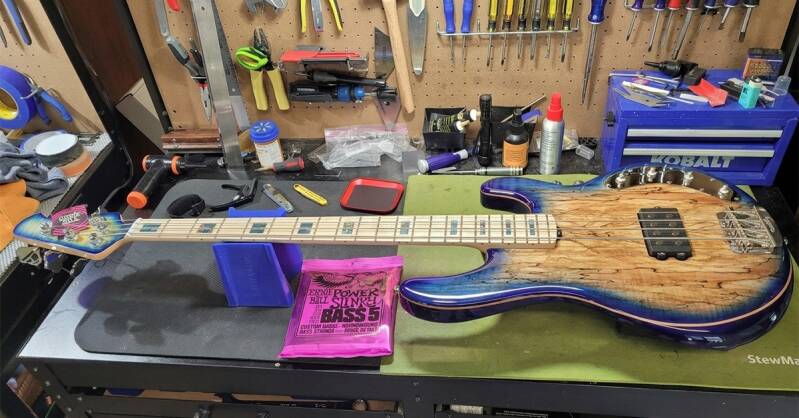
A small crack on an electric guitar may be cosmetic or a sign of deeper damage. Learn how to spot warning signs, understand crack locations, and know when professional electric guitar crack repair is needed.
There is a moment every guitar owner knows. You pick up your electric guitar, look it over, and suddenly notice a tiny crack you swear was not there yesterday.
- “Is that just in the finish?”
- “Did I damage the wood?”
- “Can I keep playing it?”
And then comes the biggest worry: “How much worse can this get?”
At Geist's Precision Guitar Repair, I have seen plenty of guitars with cracks, and I can tell you one thing right away: not every crack means the guitar is in serious trouble and needs electric guitar crack repair. But every crack deserves a closer look.
The tricky part is knowing what you are looking at.
Not Every Guitar Crack Means the Same Thing
When someone brings me an electric guitar with a crack, I do not immediately assume the worst. I first want to understand what caused it and where the crack is located.
A crack may be:
- Only in the finish
- In the wood beneath the finish
- Around a joint or body seam
- Near the neck
- Around a bridge or other stressed area
- Caused by an impact, pressure, or changes in temperature and humidity
You might be thinking, “But it is such a tiny line. How serious could it really be?”
That is a fair question.
A small finish crack can be mostly cosmetic. A small wood crack in the wrong place can be a much bigger concern.
That is why I never judge a guitar crack by appearance alone.
What Is a Cosmetic Crack?
A cosmetic crack usually affects the finish rather than the guitar's main wood structure.
You may notice a thin line in the paint or clear coat. It can happen as a guitar ages, especially when the finish reacts to changes in temperature, moisture, or normal wear.
The guitar may still:
- Stay in tune normally
- Feel solid while playing
- Have no changes around the neck or bridge
- Show no signs of the wood separating
- Sound just as it did before
In that situation, the crack may not be an urgent structural repair.
Still, I would not recommend simply ignoring it.
“If it is only cosmetic, why should I bother?” you may ask.
Because I want to know why it happened in the first place. Looking closely can help rule out a deeper problem before a small concern becomes a costly repair.
When Does a Crack Become Serious?
This is where things get more important.
A crack becomes more concerning when it reaches the wood or appears in an area that carries a lot of stress. Cracks around the neck joint, headstock, bridge area, or other important structural points deserve careful attention.
You may notice warning signs such as:
- The crack appears to be getting longer
- The wood looks separated
- The crack changes when you apply normal playing pressure
- The guitar suddenly has tuning problems
- The neck feels different
- The bridge area looks lifted or stressed
- You hear new buzzing or changes in the guitar's response
“But it still plays fine. Can I wait?”
Maybe, but that is exactly where I would rather inspect it before you make that decision.
A guitar can continue to play while a problem is slowly developing.
Where Is the Crack Located?
Location tells me a lot.
A small crack in an open area of the body may be less worrying than a similar-looking crack close to a major joint. The same goes for the neck. A crack near the headstock can need very different attention from a line running through the finish on the back of the body.
When I inspect a guitar, I look at the whole area instead of focusing only on the visible line.
I want to know:
- How deep is the crack?
- Is the wood affected?
- Is anything moving?
- Is there stress around the area?
- Does the crack continue farther than it first appears?
- Is there evidence of an impact?
That bigger picture matters.
Should You Keep Playing a Cracked Electric Guitar?
This is one of the questions I hear often.
My answer depends on the crack.
If it is clearly a minor finish issue and the guitar is stable, playing may not be a problem. But if you see a structural crack, loose wood, movement, or a crack around a stressed area, I would stop and have it checked.
You do not need to panic. You also do not need to gamble with an instrument you care about.
And please do not press, bend, glue, or try to force the crack closed yourself.
“I watched a repair video. Could I just fix it at home?”
I understand the temptation. Guitar owners are naturally curious, and I love that. But the wrong glue, pressure, or repair method can make a later repair harder.
What Happens During Electric Guitar Crack Repair?
With electric guitar crack repair, my first step is always inspection.
I want to find the actual problem before deciding how to fix it. A repair should match the damage, not simply cover what you can see.
Depending on the situation, the work may involve:
- Checking the depth and direction of the crack
- Stabilizing damaged wood
- Repairing the affected area
- Cleaning and preparing the surface
- Blending or touching up the finish when needed
- Checking the guitar after the repair
My goal is not simply to make the crack disappear from across the room. I want the repair to make sense for the guitar and its condition.
What About Electronics?
Sometimes a cracked guitar also needs attention in other areas, but I keep those problems separate.
For example, if you are already having work done, you may ask about an electric guitar electronics upgrade because your pickups, wiring, or controls are giving you trouble.
That can be worth discussing, but a crack should be assessed first. A new pickup will not solve a structural problem, and a wiring upgrade should not distract from damage that needs attention.
One problem at a time. Get the guitar stable first.
Do Not Let a Tiny Crack Keep You Guessing
I know how easy it is to stare at a crack and keep asking yourself, “Is this serious?” You may be afraid of hearing that your guitar needs major work. You may also worry that bringing it in will turn a tiny issue into a huge repair.
I get that.
My job is not to scare you. My job is to look carefully, explain what I see, and help you understand your options.
Sometimes the answer is, “It is mostly cosmetic.”
Sometimes it is, “This needs attention before you keep playing.”
Both answers are useful.
Final Insights:
Your electric guitar has probably been part of your life for a reason. Maybe you bought it for your first gig. Maybe it was a gift. Maybe you have owned it for decades. Either way, a crack can leave you wondering what happens next.
If you notice a crack, do not guess. Bring it to someone who understands how guitars are built and repaired. At Geist's Precision Guitar Repair, I take the time to inspect the damage, explain what I find, and treat your instrument with the same care I would want for my own.
With electric guitar crack repair, the right answer starts with knowing what the crack really is.