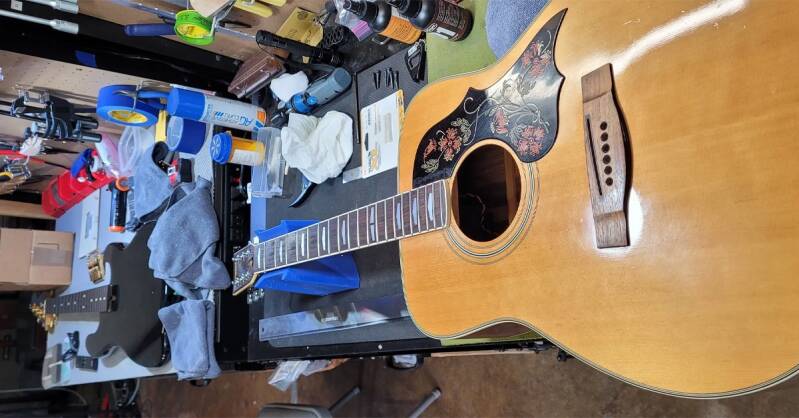
This blog explains what can happen when guitar neck problems are ignored, including playability issues, poor sound, and fret buzz. It covers common warning signs, the importance of timely guitar neck repair, guitar fret buzz repair, professional solutions, and keeping your guitar performing its best.
If you are reading this, there is a good chance you already feel something is “off” with your guitar. Maybe the action feels higher than it used to.
Maybe you are hearing that annoying buzz.
Or maybe something just does not feel right when you play a simple chord.
I want to talk to you directly about this, because I see this situation all the time in my work at Geist’s Precision Guitar Repair. And I can tell you one thing from experience: ignoring neck problems is never harmless. It always grows into something bigger.
Let me explain this in detail.
When The Guitar Neck Starts Speaking, Listen Early
The neck of your guitar is not just a piece of wood. It controls the entire feel of your instrument. When it starts to shift, bend, or lose balance, your guitar is basically telling you something is wrong.
You might notice things like:
- Strings feel harder to press
- Notes are not clean anymore
- You hear buzzing when you play
- Chords do not sound clear even with new strings
At this point, many players think, “Maybe I just need new strings” or “I will get used to it.”
But here is the truth I have seen again and again: this is often the beginning of a real guitar neck repair situation.
And the earlier we fix it, the easier and cheaper it is to solve.
What Actually Happens If You Ignore It
Let us talk honestly. What really happens when you keep playing without fixing the neck issue?
1. The Guitar Becomes Harder To Play
A small neck issue slowly changes string height and tension. That means your fingers start working harder for every chord and note.
I often hear players say: “Why does my guitar suddenly feel so heavy to play?”
It is not you. It is the setup changing over time.
2. Guitar Fret Buzz Repair Becomes Unavoidable
One of the first signs people ignore is fret buzz. At first, it is mild. You only hear it sometimes.
But if the neck problem is not corrected, that buzz spreads across more frets and more strings.
What starts as a small issue turns into a full guitar fret buzz repair job that could have been prevented with a simple adjustment earlier.
3. Permanent Fret And Neck Damage Can Develop
This is where things get serious.
If a neck problem continues for too long, it can cause:
- Uneven fret wear
- High or low fret sections
- Neck bowing or twisting
At that point, the repair is no longer simple. It may require detailed fretwork or even structural correction.
I always tell players this gently but clearly: wood remembers stress. And guitars do not fix themselves.
4. Your Tone Slowly Disappears
You might not notice this immediately, but your sound starts losing clarity.
Chords sound dull. Notes do not ring properly. The guitar feels “dead” even though everything looks fine from the outside.
Many players think it is their amp, pickups, or strings. But often, the real issue is inside the neck alignment.
5. Small Issues Turn Into Expensive Repairs
This is something I really want you to avoid.
A small setup correction is simple. But if ignored, it can turn into:
- Full fret leveling
- Neck resets
- Hardware and electronics stress repair
What could have been a quick fix becomes a longer process.
And honestly, nobody wants that for their guitar.
Why Guitar Neck Problems Are So Easy To Miss
Let me ask you something.
Have you ever slowly adjusted to a problem without realizing it?
That is exactly what happens with guitars.
You start playing a little differently. You press harder. You change your hand position. You blame your skill. But the real issue is physical, not personal.
The neck slowly shifts over time due to:
- Temperature changes
- Humidity
- String tension
- Regular use
And because it happens slowly, your brain adapts before you notice the problem.
My Experience: What I See Every Day
At Geist’s Precision Guitar Repair, I work on all types of guitars: electric, acoustic, and bass.
And I see a common pattern.
A player comes in saying: “My guitar just does not feel right anymore.”
When I check it, I usually find a neck issue that started months ago.
Sometimes it is simple. A proper setup brings it back to life.
Sometimes it has already affected the frets and needs more detailed work.
But every time, the player says the same thing: “I wish I came earlier.”
That is exactly why I am writing this for you.
Guitar Neck Repair Is Not Just Fixing Damage
I want to be clear about something.
Guitar neck repair is not only about fixing problems. It is about restoring the feel of your instrument.
When done right, it brings back:
- Smooth playability
- Clean tone
- Comfortable hand movement
- Better response while playing
And when combined with proper setup work, your guitar can feel better than you remember.
What I Want You To Remember
If your guitar neck feels even slightly off, do not ignore it.
Ask yourself:
- Does it feel harder to play than before?
- Is there buzzing that was not there earlier?
- Does something feel “off” even if you cannot explain it?
If the answer is yes, your guitar is already asking for attention.
And the earlier you act, the easier it is to fix.
How I Approach It At Geist’s Precision Guitar Repair
Every guitar that comes to us is treated with care. I personally look at each instrument like it has its own story.
I focus on:
- Precise setup and adjustment
- Detailed fretwork when needed
- Neck correction and stability checks
- Electronics inspection if sound is affected
- Full guitar fret buzz repair when required
And I do not rush the process. Because precision matters more than speed.
I also work on electric, acoustic, and bass guitars with the same level of care.
And yes, I offer pickup, drop-off, and shipping options so players do not have to worry about access.
I also provide a 30-day repair warranty because I stand behind the work I do.
Certified Warranty Service Matters
Something important I want you to know.
We are now an authorized warranty service center for Martin guitars. That certification is not easy to get. It is earned through strict standards and training.
We are also certified for Ovation guitars warranty service.
This matters because it means certain guitars can only be serviced by certified technicians if you want to keep their warranty valid.
So if you own one of these instruments, it is important you know where it is being serviced.
Final Insights:
I am not here to scare you. I am here to help you avoid something I see every week.
Small neck issues do not stay small. They grow quietly.
But the good news is this: most of them are completely fixable when caught early.
At Geist’s Precision Guitar Repair, my goal is simple. I want your guitar to feel like an extension of you again, not something you struggle with.
If your instrument is not playing the way it used to, do not wait until it gets worse.
Because sometimes, the difference between a simple adjustment and a major repair is just time.